Cleopatra's Antique Pool
A thermal pool where you swim among ancient marble columns toppled into the water by an earthquake; the water stays warm year-round.
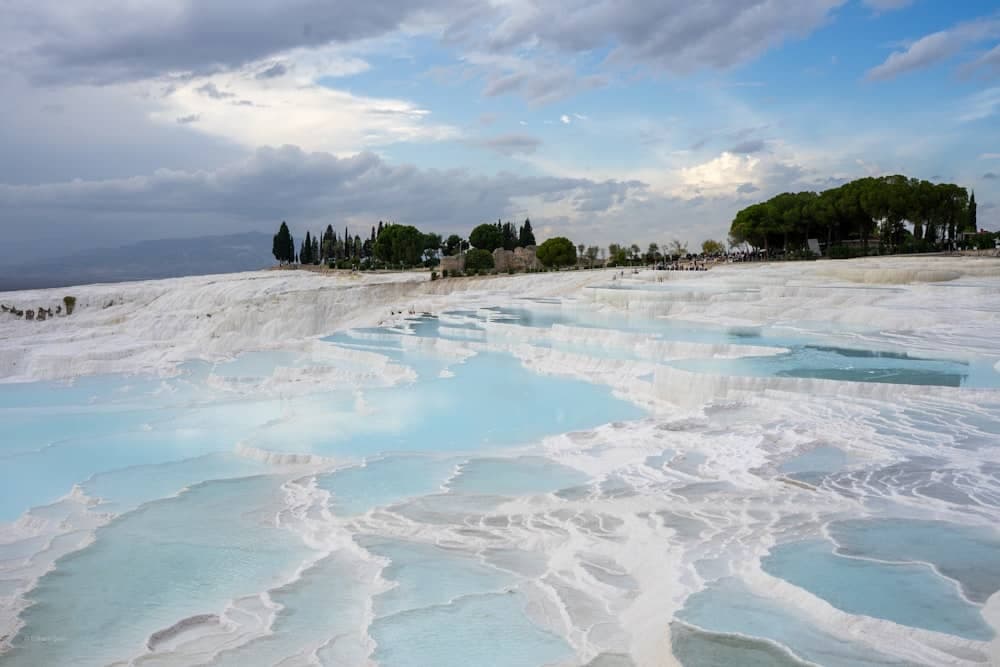
White travertine terraces woven down the hillside by calcium-carbonate-rich thermal waters; famous for the barefoot walk and its sunset views.
Pamukkale's white appearance is created by thermal water rich in calcium bicarbonate rising to the surface along a fault line. The springs on the hillside vary in temperature between 35 and 56 °C; as the water reaches the surface it releases carbon dioxide into the atmosphere, and the dissolved calcium carbonate precipitates as layers of solid calcite (travertine).
This deposition has been going on since the Middle Pleistocene — for hundreds of thousands of years — and continues today: the travertines are not a fossilised monument but a living geological process that is still growing. The result is a series of natural pools rising step by step up the hillside, and white terraces resembling a frozen waterfall.
As you walk around, you may notice that some terraces are dry — this is not a sign of fading. To preserve the whiteness, the thermal water is directed among the terraces in rotation; a section that looks dry is simply waiting its turn.
To protect the natural structure of the travertines, wearing shoes on the terraces is prohibited — visitors walk the designated route barefoot. This rule both prevents wear on the calcite surface and preserves the mineral balance of the travertine.
Along the walking route there are shallow pools of water and a rough calcite surface; stepping carefully, ideally in the early morning, makes for a cooler and less crowded experience.
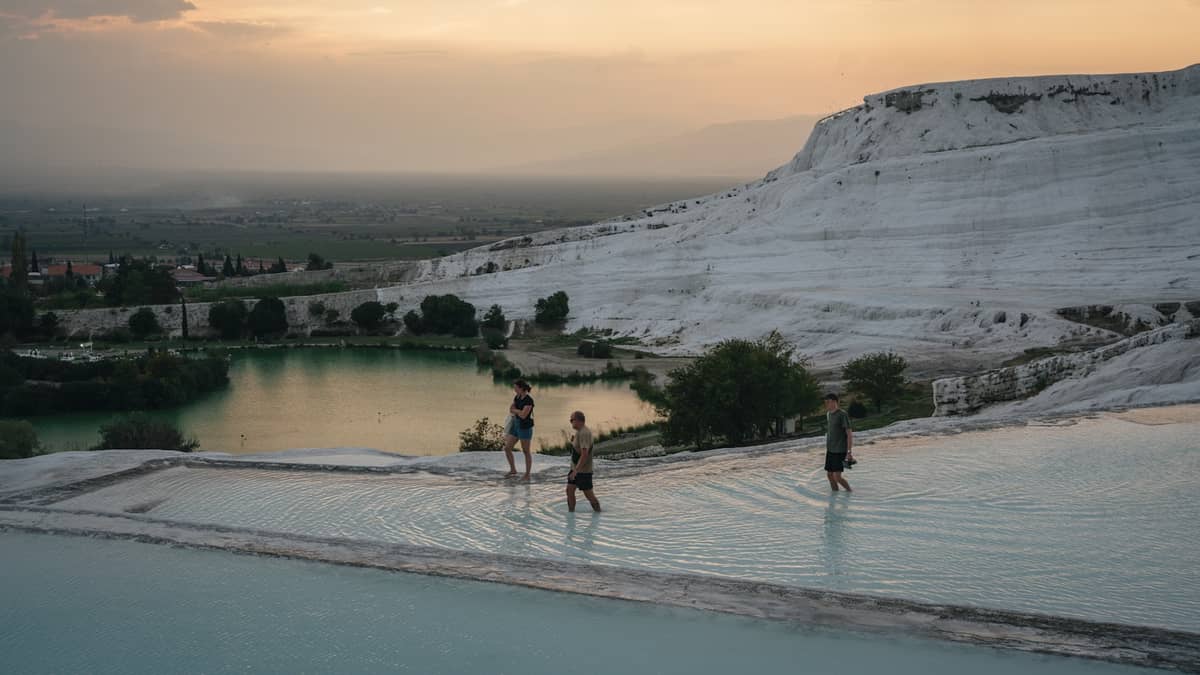
From the top of the travertines you can see both the ruins of the ancient city of Hierapolis and the Denizli plain stretching out below. At sunset the white travertine surface turns shades of orange and pink; this is one of the region's most photographed sights.
The upper terrace can also be reached via a walking path that passes through the ruins; this route combines the travertine steps with the fabric of the ancient city in a single walk. For the structures of the ancient city, see the Hierapolis page; for the thermal pool where you swim among the columns, see the page for Cleopatra's Antique Pool.
Fees and hours may change — verify before you visit. Last verified: 2026-08