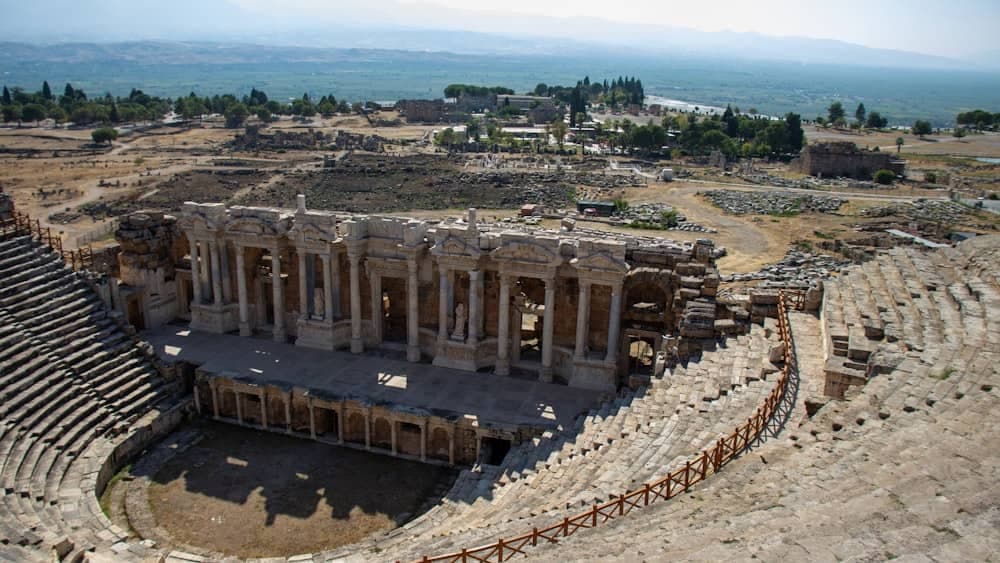
The Ancient Theatre of Hierapolis
A Roman theatre set against the hillside with room for around 12,000 spectators; with its monumental stage building and marble reliefs, it is the best-preserved structure of the ancient city.
A Roman-Byzantine city built just above the white travertines and inscribed on the UNESCO World Heritage List; known for its healing thermal springs, its vast theatre and its extensive necropolis.
Hierapolis was founded in the early 2nd century BC by Eumenes II, king of Pergamon, and later passed under Roman rule. The origin of the name is debated: one tradition links it to Hiera, wife of the legendary founder of Pergamon, while another reading takes it directly to mean 'sacred city' — the city's reverence for its thermal spring supports either reading.
Because the region lies within an earthquake zone, the city was destroyed and rebuilt many times throughout its history; the reconstruction that followed the great earthquake of AD 60, in the reign of Nero, which levelled the city, gave the Roman fabric seen today its shape.
In the Byzantine period Hierapolis became an important centre of Christianity, and buildings dedicated to the Apostle Philip rose in the city. This fabric, where Roman, Early Christian and Byzantine layers are intertwined, makes the city a rare site with the character of an open-air museum.
The reason Hierapolis was founded lies in the same thermal springs that also formed the travertines. Rich in minerals, the hot waters drew those seeking healing to the city from antiquity onward; the city earned fame as a kind of health and pilgrimage centre.
The most visible legacy of this spa tradition is the thermal pool set over the city's sacred spring, known today as Cleopatra's Antique Pool. The reverence shown to the spring also explains the city's religious character and the extraordinary size of its necropolis.
The city was laid out along the backbone of a colonnaded main street (Frontinus Street) running north–south; the monumental Frontinus Gate at the street's northern end and the city walls still stand today. Around the street are the agora, the latrine and the bath buildings — the great Roman bath now houses the Hierapolis Archaeology Museum.
Higher up the slope are the theatre, the sanctuary of Apollo and the Ploutonion, famous for its poisonous gas; at the northern exit lies the necropolis, one of the largest ancient cemeteries in Anatolia. Using the sub-topics below, you can explore the ancient theatre, the necropolis and the Ploutonion one by one.
In 1988 Hierapolis was inscribed on the UNESCO World Heritage List together with the Pamukkale travertines as a single site — one of the few 'mixed' (both natural and cultural) properties on the list. The two areas are part of the same site and are usually visited together; from the top of the travertine terraces you walk on into the fabric of the ancient city.
Starting your visit early in the day protects you from both the heat and the crowds; the site is large and shade is scarce.
Fees and hours may change — verify before you visit. Last verified: 2026-08
A Roman theatre set against the hillside with room for around 12,000 spectators; with its monumental stage building and marble reliefs, it is the best-preserved structure of the ancient city.
One of the largest ancient cemeteries in Anatolia; tumuli, sarcophagi and monumental tombs stretching for kilometres along the edges of the city's roads.
An ancient cult site famous for the toxic carbon dioxide gas rising from underground; in antiquity it was regarded as the gateway of Pluto, god of the underworld.