Stage Reliefs
The marble friezes adorning the theatre's stage building — Roman-era relief panels recounting the mythology of Apollo and Artemis.
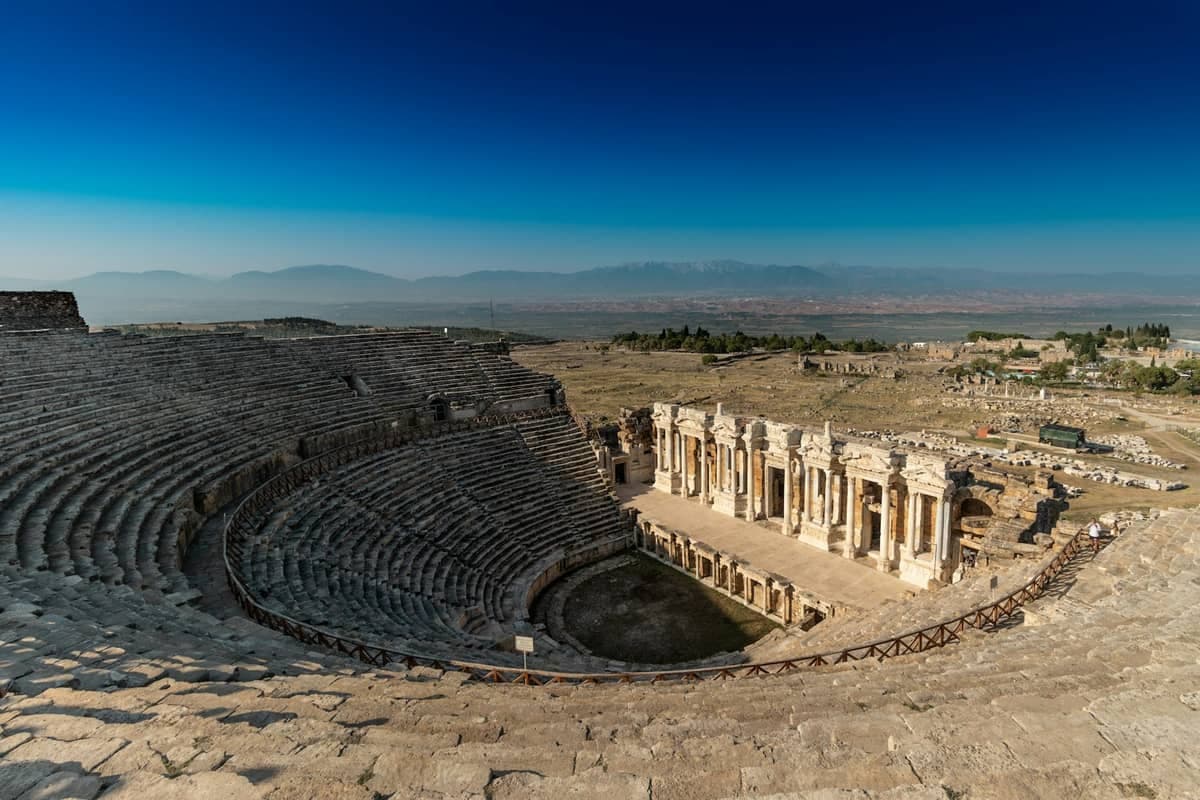
A Roman theatre set against the hillside with room for around 12,000 spectators; with its monumental stage building and marble reliefs, it is the best-preserved structure of the ancient city.
In keeping with the Roman theatre tradition, the theatre is set into a hillside; the seating tiers (cavea) rest on the natural slope and surround the semicircular orchestra area at the centre. The cavea is about 103 m in diameter and carries fifty rows of seats; scholarly estimates put the capacity between 10,000 and 12,500 spectators — that is, roughly 12,000 people.
Construction began in the late 1st century AD, after the earthquake of AD 60; the building was largely completed in the reign of Hadrian (AD 117–138). Looking from the rows of seats towards the stage, the multi-storey stage building rising behind dominates the entire composition.
The theatre's most striking feature is the monumental facade (frons scaenae) rising behind the stage. The present three-storey facade is the product of the major renovation carried out in the reign of Septimius Severus (AD 193–211) and is adorned with marble relief friezes depicting mythological scenes; a cycle of more than a hundred figured depictions relating to Apollo, the city's chief god, and to Artemis stands out.
Some of the reliefs are preserved in situ, while others are on display at the Hierapolis Archaeology Museum. For the detail of these friezes and the stories they tell, see the Stage Reliefs page under this topic.
The theatre has been the focus of restoration work ongoing since 1977; the most comprehensive phase was the 2004–2014 campaign carried out by the Italian archaeological mission. Thanks to this work, most of the cavea and the stage facade can be seen standing today — which is what makes the building the best-preserved monument of the ancient city.
The theatre is a natural stop on the walking route in the upper part of the ancient city; it lies in the same area as the sanctuary of Apollo and the Ploutonion, and the three are usually visited together on a single walk. Visiting early in the day, if possible, makes for a more comfortable experience.