Ploutonion — The Gate to Hell
An ancient cult site famous for the toxic carbon dioxide gas rising from underground; in antiquity it was regarded as the gateway of Pluto, god of the underworld.
The Cult and the Toxic Gas
The Ploutonion was a sacred precinct dedicated to Pluto, god of the underworld, lying immediately beside the temple of Apollo. The carbon dioxide gas rising from the cracks in the rock here was concentrated enough to kill animals approaching the site within a short time; ancient writers described this deadly vapour in detail.
The temple's priests (the Galli) would enter the gas and come out alive, giving the impression that the god was protecting them, and with this spectacle they reinforced the sanctity of the site. Today this is thought to be not a miracle but knowledge that exploited the way the gas gathers close to the ground.
Rediscovery
The site's location was long debated; the excavations led by Francesco D'Andria of the University of Salento, with findings announced in 2013, brought to light the gate, the sacred pool in front of it and the stone seating rows built for onlookers. The many oil lamps found around the gate are taken as a sign that rituals also continued at night — this interpretation belongs to the excavation team and remains under discussion.
The discovery revealed a structure matching the ancient writers' description of 'a gate where whoever enters meets deadly vapour' exactly: a small stone arch, the mouth of a cave from beneath which thermal water and gas seep out.
What Science Says Today
Measurements published in 2018 by geobiologist Hardy Pfanz and his team, who studied the site, showed that the carbon dioxide concentration at the cave mouth reaches 91 percent. Because the gas is heavier than air, it forms a deadly 'lake' close to the ground, especially at dawn and in the evening hours, before the sun disperses the layer; this is the physical explanation for the deaths reported in the ancient sources.
These findings also reveal the logic of the ancient priests' performance: while the head of a standing person remained above the deadly layer of gas, an animal lowering itself to the ground stayed within it. The gas is still active today — insects and small animals entering the area still die.
Visiting
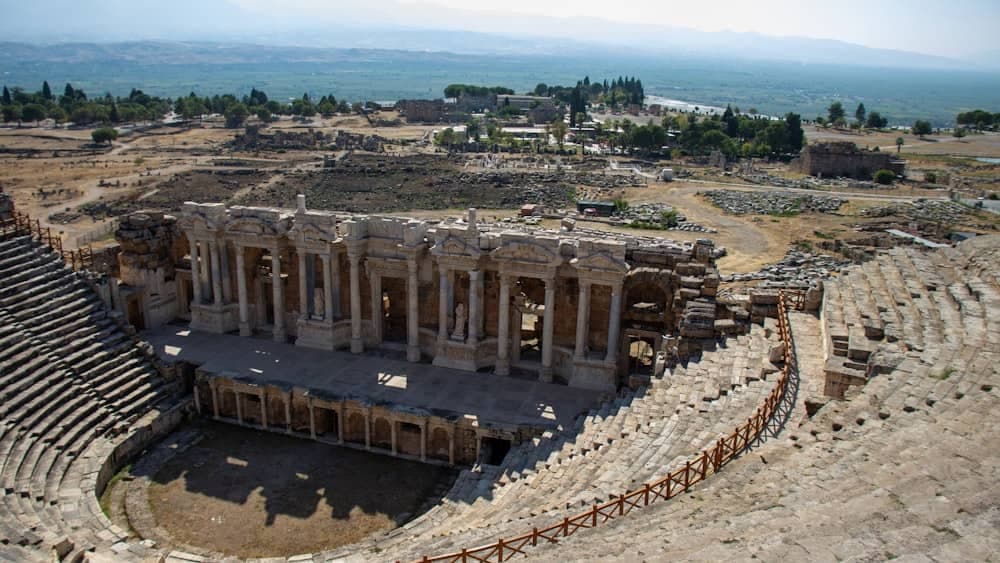
The Ploutonion lies in the same area as the temple of Apollo and the ancient theatre; these three structures are usually visited together on a single walk. The site's meaning lies less in what the eye sees than in the story it tells — reading a short information panel or taking a guided tour enriches the visit considerably.