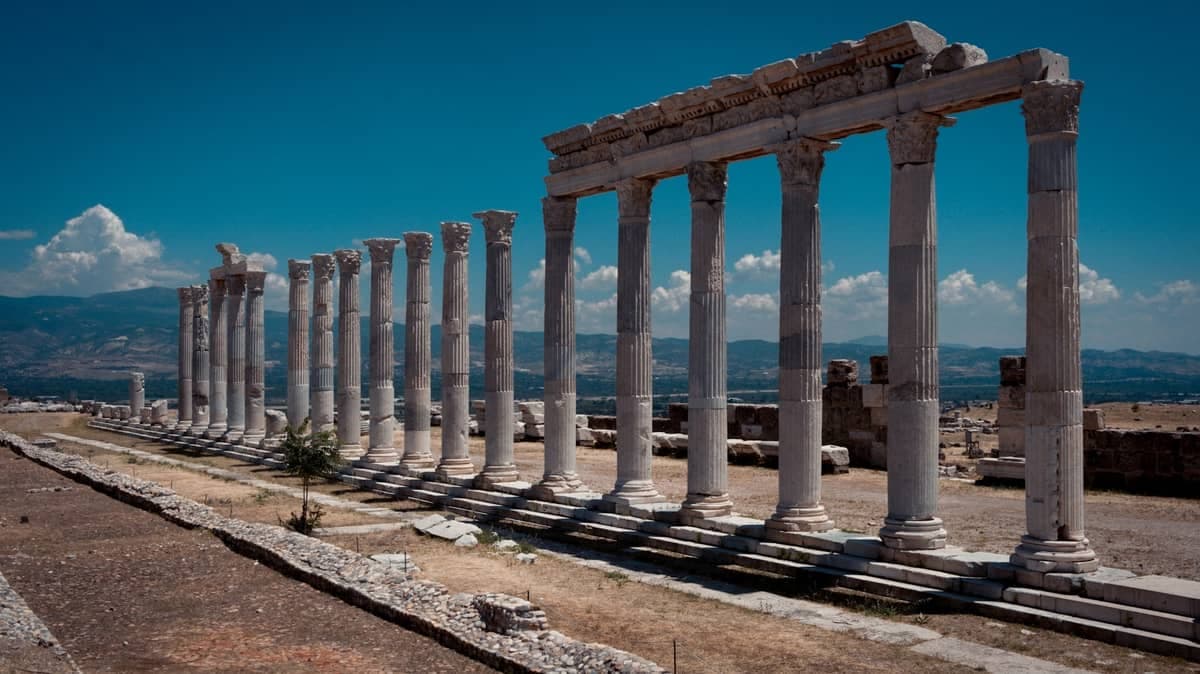
The Church of Laodicea
An Early Byzantine basilica identified in 2010 and fully excavated in a short time, its mosaics preserved in situ — the city's Seven Churches identity rendered in stone.
About 10 km from Pamukkale — the city of one of the Seven Churches of the Book of Revelation; with its colonnaded streets, its two theatres and its year-round excavation, it is the valley's fastest-emerging archaeological site.
Laodicea was founded in the middle of the 3rd century BC (around 261–253 BC) by the Seleucid king Antiochus II, who named it after his wife Laodice; the earlier settlement is reported to have borne the names Diospolis and Rhoas. The city grew rich quickly at the crossing of the trade routes of the Lycus (Çürüksu) Valley — its fame came from cloth woven with soft, dark wool, from its banking and from its medical school.
After the earthquake that levelled the city in AD 60, in the reign of Nero, the Laodiceans turned down Rome's offer of aid and rebuilt the city from their own resources — this detail, recorded by ancient writers, is the most famous proof of the city's wealth.
Today the site is on the UNESCO World Heritage Tentative List and is one of the most active excavation areas in Turkey.
Laodicea is one of the Seven Churches of Asia named in the Book of Revelation; the words 'you are neither cold nor hot' in that text were written to this city. A common scholarly reading holds that the comparison comes from the city's water: against the hot springs of Hierapolis and the cold springs of the neighbouring valley, water reached Laodicea from far away through aqueducts and arrived lukewarm — this is an interpretation, and the text itself makes no mention of water.
Its place in the history of early Christianity is not confined to that text: the Council of Laodicea, convened around AD 364, was held here, and the large church identified in 2010 has made this identity of the city visible through excavation. For the detail of the church, see the Church of Laodicea page under this topic.
The excavations run year-round under the direction of Pamukkale University (headed by Professor Celal Şimşek); the colonnaded streets have been re-erected, the West Theatre has been restored, and the church has been opened to visitors under a protective roof. The site grows a little larger each season — it is ordinary for a new building to have been raised between two visits.
As you walk the site, its backbone is Syria Street, the main axis of the city; the two theatres lie on the northern slope. From the sub-topics below you can explore the church, Syria Street and the theatres one by one.
Fees and hours may change — verify before you visit. Last verified: 2026-08
An Early Byzantine basilica identified in 2010 and fully excavated in a short time, its mosaics preserved in situ — the city's Seven Churches identity rendered in stone.
The colonnaded main street of about 900 metres running from the city centre to the Syrian Gate in the east — the backbone of Laodicea.
The West and North theatres on the northern slope of Laodicea — a pair, one restored and staging performances again, the other still under excavation.